

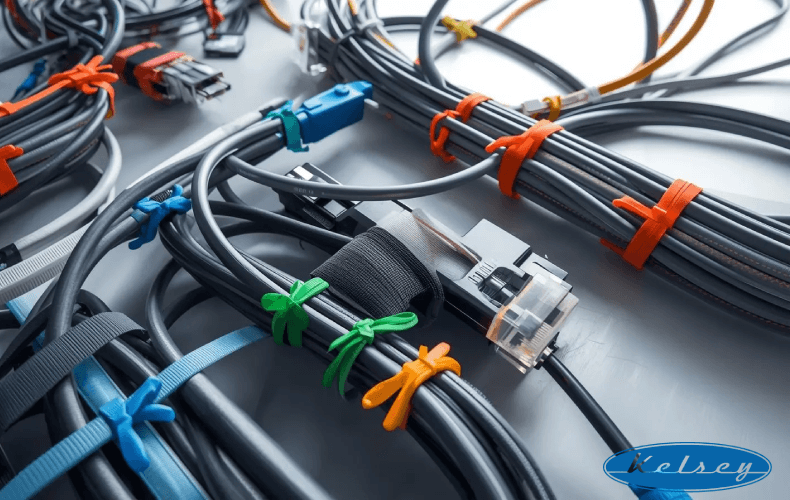
In touring, we all want the same thing: rigs that deploy fast, coil nicely, survive the truck pack, and don’t come back from the road with intermittent faults. One tempting shortcut is to strap different cable types together into a “combi” run—say power + audio, or power + network, or speaker + data—and treat it like one touring cable.
That can work when the bundle is designed as a single assembly. But it’s a risky idea when you’re simply tying very different cables together—especially when they have very different copper content (and therefore weight, stiffness and bend behaviour)—and then using them in a repeat-use environment like concert touring.
Here’s why.
1) Different copper content = different stiffness and bend memory
Copper content isn’t just about current capacity. It changes how a cable behaves mechanically:
• Heavier copper (bigger conductors, more fill) typically means higher mass and often a stiffer core.
• Lighter copper (small conductors, less fill) is typically more flexible, and will “follow” bends more readily.
When you strap those together, you’ve created a single object that doesn’t want to bend as one. On every coil, every drop, every pull, one cable is trying to take a tighter radius while the other resists. The strain doesn’t disappear—it gets pushed into the weakest places: terminations, the first 100–200mm behind connectors, and the points where the bundle is most constrained.
Touring is basically “bend fatigue training” for cables. Mixed stiffness bundles accelerate that fatigue.
2) The load path becomes uneven (and the connectors pay the price)
In a strapped bundle, the cable with more copper is usually the heavier one. In practice that means:
• During a pull, the heavy/stiff cable carries more of the tension.
• The lighter cable gets dragged along, often with micro-slips under the straps.
• At the connector ends, the bundle tries to “equalise” length by bending—creating shear and peel forces right where you don’t want them.
The result is classic touring failures:
• broken conductors at the back of a connector,
• shield/earth fatigue,
• intermittent faults that only show up when the cable is moved a certain way.
If you’ve ever had a cable that tests fine on a bench and fails when you wiggle it this is how you breed those faults.
3) Different stretch under tension = micro-movement and abrasion
Even if two cables are the same length, different constructions stretch differently under load. Over time, that leads to:
• Creep: one cable slowly “walks” relative to the other under repeated pulls.
• Fretting/abrasion under straps, especially if one jacket is softer.
• Jacket damage that starts invisible and becomes a split or flat spot later.
Touring environments add grit, truck dust, and moisture—perfect ingredients for abrasion to turn into premature jacket failure.
4) You trap heat and reduce serviceability
Bundles look tidy, but bundling has side effects:
• Power cables can warm under load; bundling can reduce airflow and increase local temperature. That matters more with higher currents and tightly strapped looms.
• Troubleshooting becomes slower. A fault in one leg often means the whole bundle comes out of service, even if the other cable is fine.
• Repairs become messy: you can’t easily re-terminate or swap one element without disturbing the whole run.
On a tour, time is everything. Anything that makes fault isolation harder is a hidden cost.
5) Coiling and handling becomes inconsistent
Crew members coil by feel. If a loom has one cable that wants to fight the coil, people compensate without thinking:
• tighter wraps,
• twisting to force it flat,
• yanking the last loop to “make it behave”.
Those habits add torsion and tight bend radii—again, right near the connectors. It’s not that anyone is doing it “wrong”; it’s that the bundle forces bad handling.
6) Electrical interactions aren’t the main issue but they can bite
Most problems here are mechanical, but it’s worth noting:
• Strapping certain signal cables alongside power can increase exposure to EMI, especially if shielding/grounding is marginal or terminations aren’t robust.
• Poorly planned bundles can make noise issues harder to diagnose because the physical layout is “baked in.”
If the loom is designed properly, these risks can be managed. If it’s improvised, they often aren’t.
What to do instead (tour-proof approaches)
If you genuinely need “one run for everything”, do it in a way that’s designed for repeat use:
1) Use a purpose-built combination cable
A true combi cable shares:
• the same overall jacket system,
• matched bend behaviour,
• proper internal strain relief.
That’s fundamentally different from strapping two unrelated cables together.
2) If you must bundle, match the mechanical characteristics
Try to keep together cables that are close in:
• OD (diameter),
• minimum bend radius,
• jacket hardness,
• weight per metre,
• flexibility at low temperature.
“Similar feel” is a surprisingly good rule in the field.
3) Use proper breakout and strain relief
The most common failure is at the ends. If bundling is unavoidable:
• add proper fan-outs/breakouts,
• use boots/heatshrink transitions,
• ensure each cable has independent strain relief before it becomes a bundle.
4) Prefer soft, wide loom management over hard ties
Hard zip ties concentrate pressure and encourage abrasion.
• Use hook-and-loop with appropriate width,
• avoid over-tightening,
• space straps sensibly so the bundle can flex evenly.
Bottom line
Concert touring is a mechanical torture test: coils, drops, pulls, cold trucks, hot stages, and fast turnarounds. Strapping together cable types with vastly different copper content usually means vastly different mechanical behaviour. That mismatch concentrates stress where cables are weakest, increases micro-movement and abrasion, and turns “neat and tidy” into intermittent faults and early failures.
If you want touring reliability, treat the loom as a product in its own right: either use a true combination cable, or build bundles from mechanically matched elements with proper breakouts and strain relief.